
Preventing suicide before the fire starts
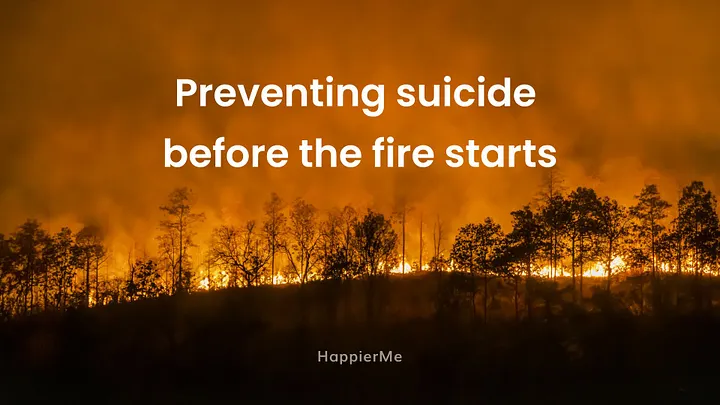
Across Europe, we have seen devastating wildfires destroy homes, habitats and communities. They offer us a powerful analogy for how we think about suicide prevention.
When a fire is raging, everything must be done to put it out. Firefighters, emergency services and communities mobilise to save lives. But even when the fire is eventually extinguished, enormous damage may already have been done, and recovery can take years.
That is why fire services don't only fight fires. They also invest in prevention: identifying risks, educating people, installing smoke alarms, creating fire breaks and trying to stop fires starting in the first place.
Could we apply the same thinking to suicide prevention?
The scale of the challenge
The latest SPARK (2026) report figures underline why we urgently need to think differently.
About 16% of people in the UK report poor mental health. A third of people know someone who has self-harmed. 42% of people have suicidal thoughts, and 18% planned a suicide attempt.
In 2024, 6,190 suicides were registered in England and Wales , equivalent to 11.4 deaths per 100,000 people. The rate has changed little from the previous year.
Behind every one of these numbers is a human life — and families, friends and communities left dealing with an unimaginable loss.
These figures should make us ask an important question: alongside helping people when they reach crisis, are we doing enough to prevent them reaching that point in the first place?
We need crisis services — but we also need to go upstream
Much of our approach to mental health and suicide prevention understandably focuses on the point at which someone is already struggling.
We provide crisis lines, counselling, medication, therapy and emergency mental health services. These services are vital and save lives every day. We need to strengthen them and make them easier to access.
But we also need to ask a different question: what was happening in someone's life and mind in the months or years before they reached that point of crisis, and could we have helped earlier?
Rather than continually pulling people out of a river when they are drowning, we also need to go upstream and discover why they are falling in.
Emotional distress rarely begins overnight
Life will inevitably bring challenges: relationship breakdown, bereavement, bullying, financial difficulties, problems at work, loneliness, failure, illness, rejection or uncertainty about the future.
We cannot prevent all of these things from happening. But we can help people develop the emotional skills to meet life's challenges differently, and not go under.
I remember an anesthetic colleague of mine. He was highly educated and successful. Following a patient complaint, he was suspended while it was investigated. Tragically, unable to cope with the emotional crisis that followed, he took his own life.
It left me with a question that has stayed with me ever since: why do we spend so many years educating people for life, yet teach them so little about how to understand and manage their own mind?
We learn mathematics, science and history. We train for our careers. We exercise to keep our bodies healthy.
But how many of us have ever been taught what to do when our mind is overwhelmed by fear, shame, loss, rejection or despair?
Emotional fitness should begin long before a crisis
This is where self-awareness can play an important role in prevention.
Our minds react automatically to what happens around us. Something happens, we have a thought or feeling, and before we know it we may be caught in anxiety, anger, shame or hopelessness.
Self-awareness helps us notice what is happening inside us.
We can begin to recognise the unconscious patterns that shape our reactions: comparing ourselves with others, needing approval, being excessively self-critical, worrying about what others think, carrying hurts from the past, or assuming that because we feel something strongly, it must be true.
Once we can see these patterns clearly, we have an opportunity to respond differently.
This is not something we should wait to teach people until they are unwell. It is something all of us can learn while we are well — when the sun is shining — not in the middle of a storm.
We need both the fire extinguisher and fire prevention
At HappierMe , we think about mental health in both ways.
Sometimes there is already a fire burning. In those moments, breathing exercises, meditation, mindfulness, journaling and other techniques can help calm the mind. Crisis and professional services are essential when someone is at risk of suicide.
But once the immediate fire has been brought under control, we can go deeper.
Why did this particular situation cause such distress? What was happening in my thinking? What assumptions was I making? What patterns were operating without my awareness? Could I meet the same challenge differently next time?
This is why HappierMe combines tools for calming the mind with learning about stress, anxiety, relationships, loss, addiction, comparison, social media, emotional regulation and the many other factors that can contribute to emotional distress.
The aim is not simply to put today's fire out. It is to reduce the chances of the same fire starting again tomorrow.
Imagine if we started in schools
Perhaps the greatest opportunity lies with young people.
Imagine if understanding your own mind was regarded as an essential life skill, just like learning to read and write.
Young people could learn how comparison affects their self-esteem; how social media influences their thinking; how to deal with rejection and criticism; how to regulate strong emotions; how to ask for help; how to cope with loss; and how to respond when life doesn't go according to plan.
These skills would not eliminate suffering. Nor could they prevent every suicide. Suicide is complex, and its causes can include psychological, social, biological and circumstantial factors.
But they could give people greater emotional resilience to deal with the storms of life when they arrive.
A new approach to prevention
Going upstream does not mean abandoning downstream services. We need both.
We need excellent crisis services for the person who desperately needs help today.
But alongside them, we need a much more ambitious approach to prevention — in our schools, universities, workplaces, healthcare systems, families and communities.
The ambition should not simply be to help people once they become mentally unwell. It should be to equip people with the self-awareness and emotional skills that may help prevent problems escalating in the first place.
Because whether we are talking about a forest fire or a human life, prevention is not only easier than dealing with a crisis.
It can prevent enormous suffering before it begins.
Dr Manoj Krishna is a former spine surgeon, the author of Understanding Me Understanding You and Stress Free, and the founder of HappierMe — a prevention focused wellbeing and life-skills app.
Further links to explore
HappierMe website
HappierMe app
A conversation on suicide prevention
Understand your mind. Live a happier life.
Life can be tough. The HappierMe app is your personal guide to help you feel better now, but also to take you deeper to understand your thoughts and feelings. It supports you to become the person you want to be, to be happier, manage your emotions and succeed in the world. There are also coaches you can speak to through the app.
About us
Get HappierMe
Support


Copyright © 2024 HappierMe. All rights reserved
Copyright © 2024 HappierMe. All rights reserved


